Choosing the right packaging material is one of the most important steps when developing custom flexible packaging. The material structure affects product protection, shelf life, appearance, cost, sustainability, and the final customer experience.
For different products such as coffee, snacks, pet food, protein powder, cannabis, tea, frozen food, or liquid products, the packaging material should be selected based on the product’s barrier requirement, weight, storage condition, printing effect, and sealing performance.
1. Understand Your Product Requirements
Before choosing the material, you should first consider what your product needs from the packaging.
For example, dry snacks may need moisture protection, coffee usually needs aroma barrier and oxygen protection, pet food requires strong sealing and puncture resistance, while frozen food needs materials that can perform well under low-temperature storage.
Key points to consider:
- • Is the product dry, oily, powder, liquid, or frozen?
- • Does it need high oxygen or moisture barrier?
- • Does it need light protection?
- • Is the product heavy or sharp?
- • Will the bag need zipper, spout, valve, or child-resistant zipper?
- • Will the product be stored at room temperature, chilled, or frozen?
The more clearly these details are confirmed, the easier it is to select the correct material structure.
2. Common Flexible Packaging Material Structures
Flexible packaging is usually made by laminating different layers together. Each layer has a different function, such as printing, barrier protection, strength, heat sealing, or shelf appearance.
PET/PE
PET/PE is one of the most common material structures for flexible packaging. PET provides good printing performance and stiffness, while PE provides sealing performance.
It is suitable for many general packaging applications, including snacks, dry food, powder products, and daily-use packaging.
PET/VMPET/PE
PET/VMPET/PE is a high-barrier structure. VMPET provides better light, oxygen, and moisture barrier compared with regular transparent materials.
It is commonly used for coffee, snacks, pet food, cannabis packaging, tea, and products that require better shelf-life protection.
PET/AL/PE
PET/AL/PE uses aluminum foil as the barrier layer. It provides excellent oxygen, moisture, and light barrier performance.
This structure is suitable for products with strict barrier requirements, such as coffee, supplements, powder, medical-related packaging, and long shelf-life food products.
MOPP/VMPET/PE
MOPP/VMPET/PE is often used for packaging that needs a matte or premium appearance. It can provide good barrier performance and a better hand-feel depending on the surface finish.
This structure is suitable for premium food packaging, cannabis packaging, pet treats, coffee bags, and high-end retail packaging.
PE/PE Recyclable Material
PE/PE mono-material is a recyclable packaging option. It is suitable for customers who want more sustainable packaging.
Compared with traditional multi-material structures, PE/PE can support recyclability, but the barrier and stiffness need to be evaluated based on the product and bag type.
PE/EVOH-PE/PE High Barrier Recyclable Material
For products that need both recyclability and higher barrier performance, PE/EVOH-PE/PE can be considered. EVOH helps improve oxygen barrier while keeping the structure mainly PE-based.
This option is suitable for brands looking for sustainable packaging with better protection.
Kraft Paper Laminated Material
Kraft paper laminated packaging gives a natural and eco-style appearance. It is often combined with plastic film or aluminum barrier layers to improve strength and protection.
It is commonly used for coffee, tea, snacks, pet treats, organic food, and natural product packaging.
3. Choose the Right Barrier Level
Barrier performance is one of the most important factors in packaging material selection.
If the barrier is too low, the product may lose freshness, absorb moisture, oxidize, or become damaged during storage. If the barrier is too high, the packaging cost may increase unnecessarily.
General recommendations:
| Product Type | Recommended Barrier |
| Snacks | Medium moisture barrier |
| Coffee | High oxygen and aroma barrier |
| Pet food | Medium to high moisture and oxygen barrier |
| Protein powder | High moisture barrier |
| Tea | Good aroma and moisture barrier |
| Cannabis | High aroma and moisture barrier |
| Frozen food | Low-temperature resistance and strong sealing |
| Liquid products | Strong sealing and puncture resistance |
4. Consider the Bag Style
The material should also match the bag type. Some materials work better for stand up pouches, while others are more suitable for flat bottom bags, side gusset bags, roll film, or spout pouches.
For example, flat bottom bags usually require better stiffness to keep a premium shelf appearance. Spout pouches require strong sealing performance. Vacuum bags need high puncture resistance and sealing strength.
Common bag types include:
- • Stand up pouches
- • Flat bottom pouches
- • Zipper bags
- • Child-resistant zipper bags
- • Side gusset bags
- • Spout pouches
- • Vacuum bags
- • Roll film
- • Custom shaped pouches
5. Match the Material with Printing and Finish
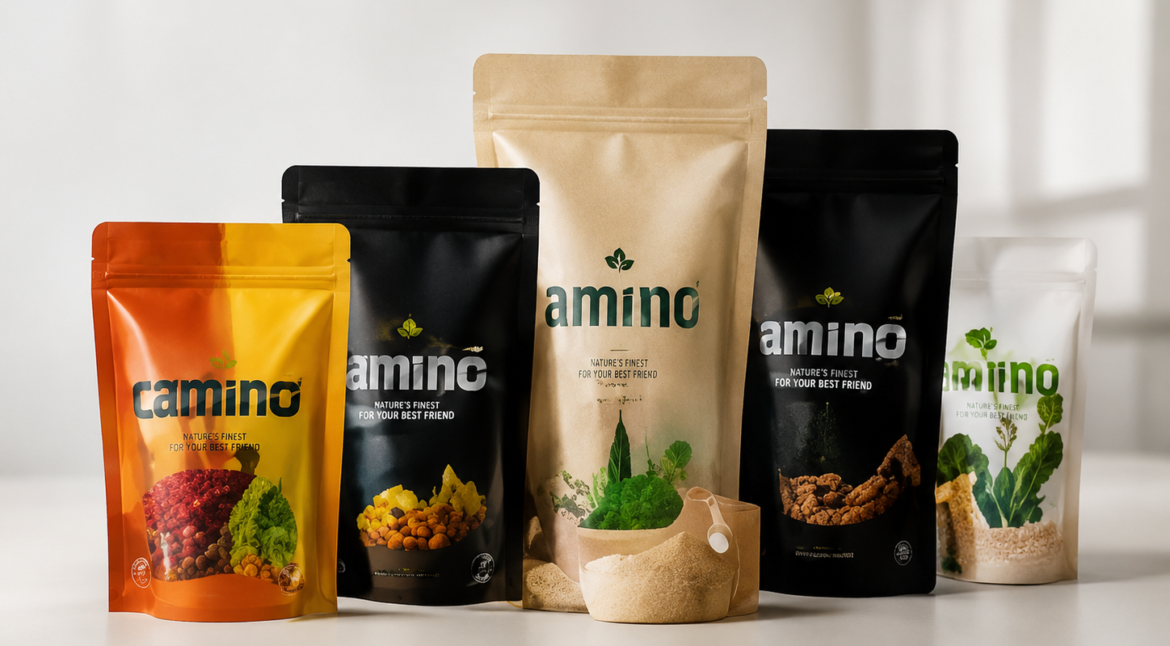
The outside layer of the material affects printing quality and surface finish. If your packaging requires bright colors, Pantone color matching, matte effect, soft touch, metallic effect, holographic effect, or spot UV, the material structure should be confirmed before production.
Common surface finishes include:
- • Glossy finish
- • Matte finish
- • Soft touch matte finish
- • Spot UV
- • Holographic effect
- • Metallic ink effect
- • Transparent window
For high-volume production, gravure printing is suitable for stable color and repeat orders. For small quantity or multiple SKUs, digital printing is more flexible and does not require printing plates.
6. Think About Sustainability
More brands are now considering sustainable packaging. However, sustainable packaging should still meet the product’s protection requirements.
Common sustainable options include:
- • Recyclable PE/PE mono-material
- • PE/EVOH-PE/PE high-barrier recyclable structure
- • PCR PE option
- • Kraft paper laminated material
- • Reduced material thickness when suitable
It is important to balance sustainability, barrier performance, sealing strength, shelf appeal, and cost.
7. Confirm Material Thickness
Material thickness affects bag strength, hand feel, sealing performance, and final cost.
Thicker material usually provides better stiffness and strength, but it also increases cost. Thinner material can reduce cost, but it may not be suitable for heavy products or large bag sizes.
The best thickness should be selected based on:
- • Product weight
- • Bag size
- • Bag style
- • Filling method
- • Shipping method
- • Shelf display requirement
8. Test Before Mass Production
Before mass production, it is always better to confirm the material, size, artwork, sealing, zipper function, and filling performance.
For new projects, samples or digital proofs can help reduce risk before bulk production. If your packaging is used on automatic filling machines, the material structure and bag dimensions should also be tested with your equipment.
Conclusion
There is no single material structure that works for every product. The best packaging material depends on your product type, barrier requirement, bag style, printing design, sustainability goal, and budget.
At PX Package, we help customers choose suitable material structures for different packaging applications, including food, coffee, pet food, protein powder, cannabis, snacks, tea, frozen food, and more.
Whether you need standard flexible packaging, high-barrier packaging, recyclable PE/PE packaging, PCR packaging, or custom printed roll film, our team can support you from material selection and artwork review to production and final shipment.
Need help choosing the right packaging material? Contact PX Package for professional packaging advice and a free quotation.