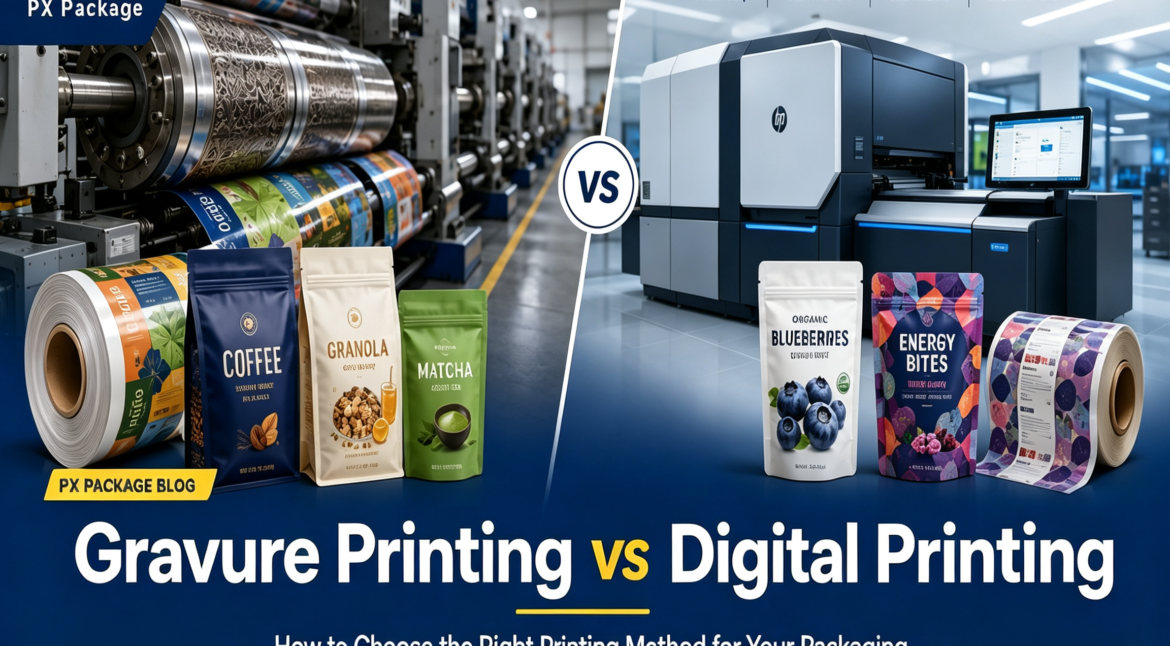
When developing custom flexible packaging, printing method is one of the key decisions that affects cost, color accuracy, lead time, MOQ, and final packaging appearance.
For flexible packaging such as stand up pouches, flat bottom pouches, zipper bags, mylar bags, roll film, and custom shaped pouches, the two most common printing methods are gravure printing and digital printing.
Both methods can produce high-quality packaging, but they are suitable for different order quantities, project stages, and design requirements. Understanding the differences can help you choose the most cost-effective solution for your packaging project.
1. What Is Gravure Printing?
Gravure printing is a traditional high-speed printing method widely used for flexible packaging. It uses engraved cylinders, also called printing plates, to transfer ink onto packaging film.
For each color in the artwork, one printing cylinder is required. For example, if your design includes white, CMYK, and spot colors, each color needs its own engraved cylinder.
Gravure printing is especially suitable for large-volume orders because once the plates are made, the printing speed is fast, the color is stable, and the unit cost becomes more competitive.
Key Features of Gravure Printing
- • Suitable for bulk production
- • Stable color performance for repeat orders
- • Good Pantone color control
- • High printing speed
- • Sharp details and strong ink coverage
- • Requires printing plates
- • Plate cost applies before production
2. What Is Digital Printing?
Digital printing does not require printing plates. Artwork is printed directly from the digital file onto the packaging material.
This makes digital printing a flexible option for small quantity orders, trial runs, multiple SKUs, or projects that require frequent design changes.
Digital printing is often used when customers want to test the market before committing to larger production quantities.
Key Features of Digital Printing
- • No printing plate cost
- • Suitable for small quantity orders
- • Faster setup for trial projects
- • Good for multiple designs or SKUs
- • Flexible for design changes
- • Unit cost is usually higher for large quantities
- • Color may have slight difference compared with Pantone reference
3. Main Differences Between Gravure Printing and Digital Printing
| Item | Gravure Printing | Digital Printing |
| Plate Cost | Required | Not required |
| MOQ | Higher | Lower |
| Unit Cost | Lower for bulk orders | Better for small orders |
| Lead Time | Longer before production due to plate making | Shorter setup time |
| Color Control | Better Pantone matching | Good, but may have slight deviation |
| Best For | Bulk orders and repeat production | Small quantity, samples, multiple SKUs |
| Artwork Changes | Plate remake may be needed | Easier to adjust |
| Printing Speed | Fast for mass production | Flexible but slower for large orders |
4. When Should You Choose Gravure Printing?
Gravure printing is recommended when your order quantity is relatively large and your design is already confirmed.
Because gravure printing requires engraved cylinders, it has an initial plate cost. However, once the plates are made, the cost per bag becomes more economical for mass production.
Gravure Printing Is Best For:
- • Large quantity orders
- • Long-term repeat orders
- • Stable product lines
- • Brands requiring consistent Pantone colors
- • Designs with strong color coverage
- • High-quality retail packaging
- • Roll film for automatic packing machines
Example
If you need 20,000, 50,000, or 100,000 pieces of custom printed pouches, gravure printing is usually more cost-effective because the plate cost is shared across a larger quantity.
5. When Should You Choose Digital Printing?
Digital printing is recommended when your quantity is small, your project is still in the testing stage, or you have many SKUs with different designs.
Since digital printing does not require plates, it is more flexible and faster for small runs. It is especially useful for new brands, seasonal packaging, limited editions, or product launches.
Digital Printing Is Best For:
- • Small quantity orders
- • Market testing
- • Sample production
- • Multiple SKUs
- • Short-term promotional packaging
- • New product launches
- • Designs that may change frequently
Example
If you need 500, 1,000, or 2,000 pieces for several different flavors, digital printing may be a better choice because you can avoid plate cost and test the market first.
6. Which Printing Method Has Better Color?
For strict Pantone color matching and repeat production, gravure printing usually has better color stability.
Gravure printing uses fixed cylinders and controlled ink systems, so it is easier to keep the same color across future repeat orders.
Digital printing can also produce attractive colors, but the color result may be slightly different from Pantone colors because it is based on digital color output.
Simple Recommendation
- • If color consistency is very important, choose gravure printing.
- • If flexibility and small quantity are more important, choose digital printing.
7. What About Plate Cost?
For gravure printing, plate cost is required because each color needs one cylinder. The more colors your artwork has, the more plates are needed.
For example:
- • White ink layer = 1 plate
- • CMYK = 4 plates
- • Spot color = 1 plate each
If your design has white + CMYK + 2 spot colors, it may require 7 plates.
Digital printing does not need plates, so it can reduce the initial cost for small orders. However, for large quantities, digital printing usually has a higher unit price than gravure printing.
8. Which Method Is Faster?
Digital printing usually has a faster setup because no plate making is required.
Gravure printing requires plate making first, which usually takes several days. After the plates are completed, printing itself is fast and efficient for bulk production.
General Timeline
Gravure Printing:
- • Plate making: 4–5 days
- • Printing: 1–2 days
- • Then lamination, slitting, bag making, QC, and packing
Digital Printing:
- • No plate making
- • Faster setup
- • Suitable for urgent small orders or sample runs
9. Can Both Methods Be Used for the Same Product?
Yes. Many brands use digital printing first for sample or trial orders, then switch to gravure printing for mass production.
This is a very practical strategy.
Suggested Development Flow
- Use digital printing for small quantity trial order.
- Test the product in the market.
- Confirm final design and material.
- Switch to gravure printing for bulk production.
- Keep the same gravure plates for repeat orders.
This approach helps reduce risk before investing in large-volume production.
10. How to Choose the Best Printing Method?
You can choose based on these questions:
Choose Gravure Printing If:
- • Your quantity is large
- • Your design is confirmed
- • You need stable repeat production
- • Pantone color matching is important
- • You want lower unit cost for bulk orders
Choose Digital Printing If:
- • Your quantity is small
- • You have many SKUs
- • You need samples or trial orders
- • Your artwork may still change
- • You want to avoid plate cost at the beginning
11. Printing Method by Product Type
| Packaging Type | Recommended Method |
| Stand Up Pouches | Gravure or Digital |
| Flat Bottom Pouches | Gravure for bulk, Digital for small runs |
| Zipper Bags | Gravure or Digital |
| Child-Resistant Bags | Gravure for bulk orders |
| Coffee Bags | Gravure for stable brand colors |
| Pet Food Bags | Gravure for large bags and bulk production |
| Roll Film | Gravure printing is usually preferred |
| Multiple SKU Trial Orders | Digital printing |
Conclusion
Gravure printing and digital printing both have advantages. The right choice depends on your order quantity, budget, lead time, color requirements, and whether the design is finalized.
Gravure printing is better for bulk orders, stable colors, repeat production, and lower unit cost at higher quantities.
Digital printing is better for small quantity orders, samples, multiple SKUs, and flexible design changes.
At PX Package, we provide both gravure printing and digital printing solutions to support different packaging projects. Whether you are testing a new product or preparing for large-scale production, our team can help you choose the most suitable printing method for your custom packaging.
Need help choosing between gravure printing and digital printing? Contact PX Package for professional advice and a free quotation.